


Huge Fidelity Is Tiny in ETFs

The news was kind of bad this week again (retail sales slumped), but the market advanced again to a new all-time high for the S&P 500 and the Russell 2000. Interestingly, the NASDAQ-100 and the Technology sector did not. Last week, I discussed how AI investment management can make us all rich.
A Look at the Market
The S&P 500 has returned 14.5% with dividends included, and the price is up 13.9% for SPDR S&P 500 ETF (SPY) in 2026 so far. This leaves the market on track to post a return for the full year above 20%. At the same time, iShares Core US Aggregate Bond ETF (AGG) has declined in price in 2026. With dividends included, the return has been -0.1%, which is well below cash.
Barron's had a cover story this week on Vanguard, calling it the King of ETFs. Here is the story online:
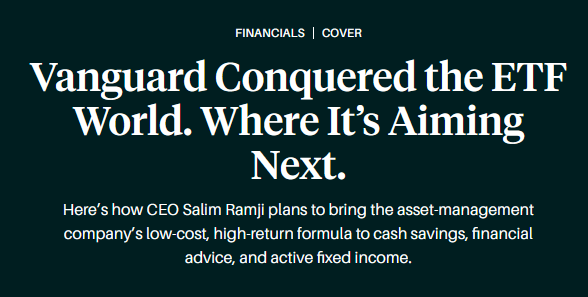
I did write about Vanguard in May on my Seeking Alpha Blog, which is freely available without a password being required. The piece was A Look at Vanguard as an ETF Powerhouse. At the time, I was following 85 ETFs (now 88), and I stated in that article that I was following 23 Vanguard ETFs (27%) and 30 from BlackRock's iShares (35%).
One very interesting graphic in the Barron's article was this:
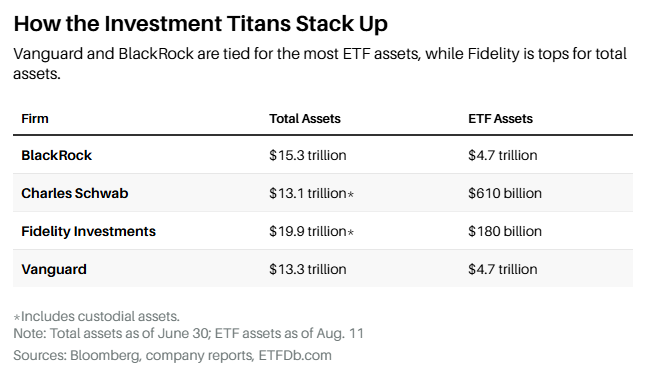
What jumps out at me, a Schwab and Vanguard customer for many years, is how Fidelity's ETF exposure is so low! The privately-owned firm has the largest total assets, but its ETF assets are the smallest of these four and represent just 1%. Vanguard, which Barron's today called the King of ETFs, is at 35%. Again, kudos to Vanguard!
Updating my ETF watchlist, I added three ETFs in July. Two of these were from Charles Schwab, and one was from Invesco. Again, I try to watch the very largest ETFs and also smaller ones that are unique among passive ETFs (I don't follow active ETFs). Looking at the providers, iShares still leads. Here is the breakdown of the 88 I follow:
iShares: 30 (34%)
Vanguard: 23 (26%)
State Street: 19 (22%)
These three represent 82% of the 88 I follow, and I have to give their size as a leading factor. Here is a breakdown of the other 16 and their weight of the total:
Invesco: 6 (7%)
Schwab: 4 (5%)
ProShares: 3 (3%)
VanEck: 2 (2%)
PIMCO: 1 (1%)
These five other providers offer ETFs that I track mainly due to their being unique, especially Invesco and ProShares. Notably, I do not track any Fidelity ETFs.
Looking at the Fidelity website, there is a page to get potential ETF investors, and this is what it looks like:

This is quite interesting! The "Overview" page discusses both its own products as well as those from iShares. Way down the page, it says this:
We've teamed up with iShares®, the ETF market leader to deliver quality investment choices designed to help you achieve your investment objectives.
This page also has a learning section and some resources that include an ETF Screener, and it calls out actively managed ETFs, thematic ETFs and Crypto investing (three Fidelity funds, all ETPs and not ETFs, and tied to bitcoin, ether or SOL).
Fidelity also has a page on its website to find an ETF, and this page lists every single Fidelity ETF. It pushes iShares ETFs too. There are a total of 86 proprietary ETFs according to ETF.com. 5 are footnoted on Fidelity's website as being different from traditional ETFs because they do not list their assets daily. 2 are footnoted as being invested significantly in collateralized loan obligations (CLOs).
Looking at the 86 by size, the very largest one is at $27 billion, the Fidelity Total Bond ETF (FBND). I follow two ETFs that are similar but both much larger. Four others have $10-11 billion assets under management. My 88-ETF list has an average size of $103.3 billion with a median of $45.5 billion.
I don't really know Fidelity that well, but it is based in Boston and employed Peter Lynch, a renowned investor for many years. Lynch does not manage any funds, but he does serve as Vice Chairman of Fidelity Management & Research Company. The smallest fund on my watchlist is currently SPDR S&P Software ETF (XSW), which I added earlier this year and did purchase (and sell later) in my model portfolio. Many of the Fidelity ETFs are smaller, and lots of them are below $5 billion. Only 8 of the 88 ETFs (9%) that I watch closely are less than $5 billion. Maybe I am missing some very small ETFs that I should be tracking due to being unique
So, Fidelity is huge with retail investors, but it is tiny in the ETF world. It does seem to serve its customers well, and perhaps this is what the relationship with iShares is all about. The ETF market has been flooded with assets entering it and new ETFs being offered. Perhaps Fidelity will consider acquiring another provider, or perhaps it doesn't want to be bigger in ETFs under its own management. Another option might be for BlackRock (BLK), which owns and operates iShares, to buy Fidelity and beef up its retail exposure physically. BlackRock has no physical locations for its customers currently (like Vanguard), and Fidelity is in over 200, which trails Schwab's 400+.
Note that I am looking for a job and have applied to two jobs with Fidelity (one in March and another in June), both of which resulted in rejections. I have also applied to jobs at other ETF providers, including iShares, Vanguard, State Street, Invesco, ProShares and PIMCO mentioned above as well as one ETF provider not mentioned above.
ETF Model Portfolio Update
This ETF model portfolio, which is measured against 60% SPY and 40% AGG, is up relative to its benchmark. This week, I did one trade again, which was published on here instead of on my Seeking Alpha blog. For those who would like real-time alerts (free of charge for now), just subscribe to the blog.
I posted no articles on ETFs or stocks this week, though I wrote a lot about some things (not investment-related as well as about another scary AI investment management software company).
Going into the week, my model portfolio equity exposure totaled 25.8%, spread out across two ETFs. Here is what I did this week:
Friday: I trimmed Vanguard Short-Term Treasury Index ETF (VGSH).
Here is the current model portfolio, which now has 26.0% equity exposure in two ETFs and fixed income exposure in four ETFs that totals 68.6%:

I have been wrong this year, at least so far, as stocks keep rallying. The rally had been until Friday nine weeks ago (June 5th), when stocks had their worst day of the year. Since then, the S&P 500 has made a new high. Small-caps did again make a new high this week too. Despite being underweight stocks all year, my return relative to the 60/40 index is higher by about 5.3% in seven and a half months. While the S&P 500 rose this week and the Aggregate Bond Index fell slightly, this model portfolio was up as much as the index during the week.
The year-to-date strong relative performance is not due to superior returns on my current equity ETFs. My TIPS ETFs have done okay relative to AGG, but they aren't exactly boosting the return. VGSH isn't helping too much either. So, what has it been? I have had positive returns from three ETFs, two of which I no longer hold and one of which is down a lot year-to-date that I just repurchased recently, and there has been some good trading.
How Can I Help You?
I enjoy analyzing ETFs and stocks, and I like sharing my thinking in writing. I was considering starting a subscription service or joining one that is already being published. What things would you as an investor like to see offered?
If you are an investment professional, I would like to work with you as well. I can help educate financial consultants about the ETFs, and I can work with management at investment firms to help create model portfolios or potential ETF investments. Please let me know if your firm would be interested in this.
My ETF articles at Seeking Alpha, written under the alias The Intelligent ETF Investor, shared a lot of my ideas. I continue to share those ideas here on this blog.


Comments