


Why I Have Reduced a Great Equity ETF

Last week, I discussed how the Magnificent 7 or Elite 8, which are lagging the rally this year, are facing extinction. I mentioned new super-mega-cap SpaceX as well as other pending IPOs.
A Look at the Market
The State Street SPDR S&P 500 ETF (SPY) shot up Monday and pulled back during the rest of the holiday-shortened week, ending up for the week, though it is still own month-to-date. It has increased in price by 9.5% and has returned 10.1% with dividends. Bonds remain under pressure, with iShares Core US Aggregate Bond ETF (AGG) now returning just 0.7% with dividends included, which is below the return on cash.
While the S&P 500 fell short of its all-time high, set in early June, the Russell 2000 did set a new all-time high on Monday. In June, the iShares Russell 2000 ETF (IWM) is up 2.0%, while SPY has lost 1.0% including dividends. Looking at the action the since the middle of the quarter, May 15th, IWM has soared 6.7%, while SPY has returned just 1.3% . Here is the performance in Q2:

Two weeks ago, I warned about small-cap stocks, and they are higher since then. My total exposure to stocks in the model portfolio has decreased, with the big drop being a 46% reduction in ProShares Russell 2000 Dividend Growers ETF (SMDV). As I have been saying when I have reduced it, I do still like it. So, why am I clipping my exposure to SMDV? Why did I get my wife to trim her exposure to it as well as small-caps in general?
SMDV was a big position in the model portfolio when I launched it at the end of 2025 at 15% (now about 4.4%). It has returned with dividends 13.6%, which is ahead of the S&P 500 but behind the R2000. While it has been strong relative to the overall market recently, it has lagged badly since the end of 2022:

ProShares, which manages SMDV, runs two other dividend-focused ETFs that I include in my model portfolio, and this newsletter addressed these three ETFs on May 16th, when I explained why I like them. Since then, I have reduced the two others ones slightly while cutting SMDV by about 68%. SMDV, up 6.2% since then, has lagged slightly IWM but has outpaced the other two ETFs. Looking at the action over the last decade, the S&P 500 has soared above the mid-cap and small-cap indices, and SMDV is in last place by far:

Being in last place does not make SMDV an automatic buy or necessarily the best. What really stands out to me is how much ProShares S&P 500 Dividend Aristocrats ETF (NOBL) has lagged the S&P 500. It is not exactly to correct to compare them as I am doing, but NOBL has returned just 48% of the return of SPY. SMDV has returned 54% of IWM. The other one, ProShares S&P MidCap 400 Dividend Aristocrats ETF (REGL) has returned 78% of the SPDR S&P 400 MidCap 400 ETF (MDY).
Yes, NOBL has outpaced SMDV substantially and REGL marginally, but it sure has lagged the S&P 500. I have all of these rated Buy at Seeking Alpha, most recently upgrading NOBL a month ago. NOBL is very different from REGL and SMDV. Not only is it exposed to larger companies, its sector exposure is much lower Utilities and especially Financials and much higher Industrials and Materials. I was bearish on large Utilities but am not neutral (and own XLU in the model portfolio)). I am concerned about large Financials and did downgrade XLF this week, but I actually like smaller Financials due to potential M&A and better valuations. Most importantly, all of these ETFs have very low exposure to Technology.
I am not a big fan of ProShares due to its very high exposure to leveraged ETFs, but they have done an excellent job with these dividend-focused ETFs. I don't think that they are necessarily buy and hold forever ideas, but I do like all of them right now. I started the year not covering NOBL and REGL and loaded up on SMDV in the model portfolio. I still like SMDV, but I have used the resurgence in small-cap stocks to move into NOBL and REGL. My index of 60% SPY and 40% AGG does not include mid-caps or small-caps! I do hope that I can boost SMDV at lower prices as small-caps pull back.
ETF Model Portfolio Update
This ETF model portfolio, which is measured against 60% SPY and 40% AGG, is up relative to its benchmark. This week, I did several trades, which were published on here instead of on my Seeking Alpha blog.
I also posted two articles at Seeking Alpha about ETFs:
I wrote about two stocks, Adobe (ADBE) at TalkMarkets and Shoe Station (SHOE) at Seeking Alpha:
Going into the week, my equity exposure totaled 30.9%, spread out across four ETFs. Here is what I did this week:
Monday: I reduced iShares Bitcoin Trust ETF (IBIT) and added to Vanguard Short-Term Inflation-Protected Securities Index ETF (VTIP).
Tuesday: I reduced State Street Utilities Select Sector SPDR ETF (XLU) to add to VTIP again.
Wednesday: I trimmed Vanguard Short-Term Treasury Index Fund ETF (VGSH) and boosted IBIT
Thursday: I did the VGSH to IBIT swap again.
Here is the current model portfolio, which now has 29.0% equity exposure in four ETFs and fixed income exposure in three ETFs that totals 59.6%:
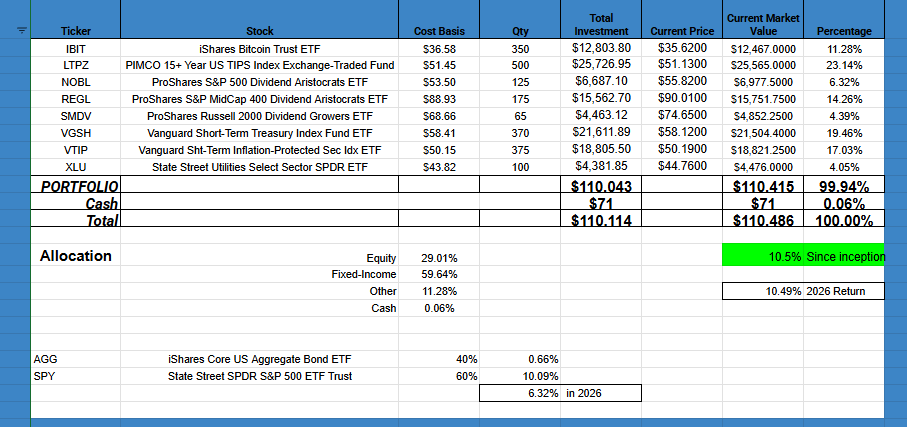
I have been wrong this year, at least so far, as stocks keep rallying. The rally has been until Friday two weeks ago, when they had their worst day of the year. Despite being underweight stocks all year, my return relative to the 60/40 index is higher by about 4% in less than six months. This is not due to superior returns on my current equity ETFs, as the very best one, SMDV, has increased in price by 13.0%. My TIPS have done okay relative to AGG, but they aren't exactly boosting the return. VGSH isn't helping too much either. So, what has it been? I have had positive returns from two ETFs, one of which I no longer hold and one of which is down a lot year-to-date that I just repurchased recently, and there has been some good trading. I plan to give a performance attribution after the end of Q2 for this quarter.
How Can I Help You?
I enjoy analyzing ETFs and stocks, and I like sharing my thinking in writing. I am working on starting a subscription service at Seeking Alpha. What things would you as an investor like to see offered?
If you are an investment professional, I would like to work with you as well. I can help educate financial consultants about the ETFs, and I can work with management at investment firms to help create model portfolios or potential ETF investments. Please let me know if your firm would be interested in this.
My ETF articles at Seeking Alpha, written under the alias The Intelligent ETF Investor, share a lot of my ideas.


Comments